
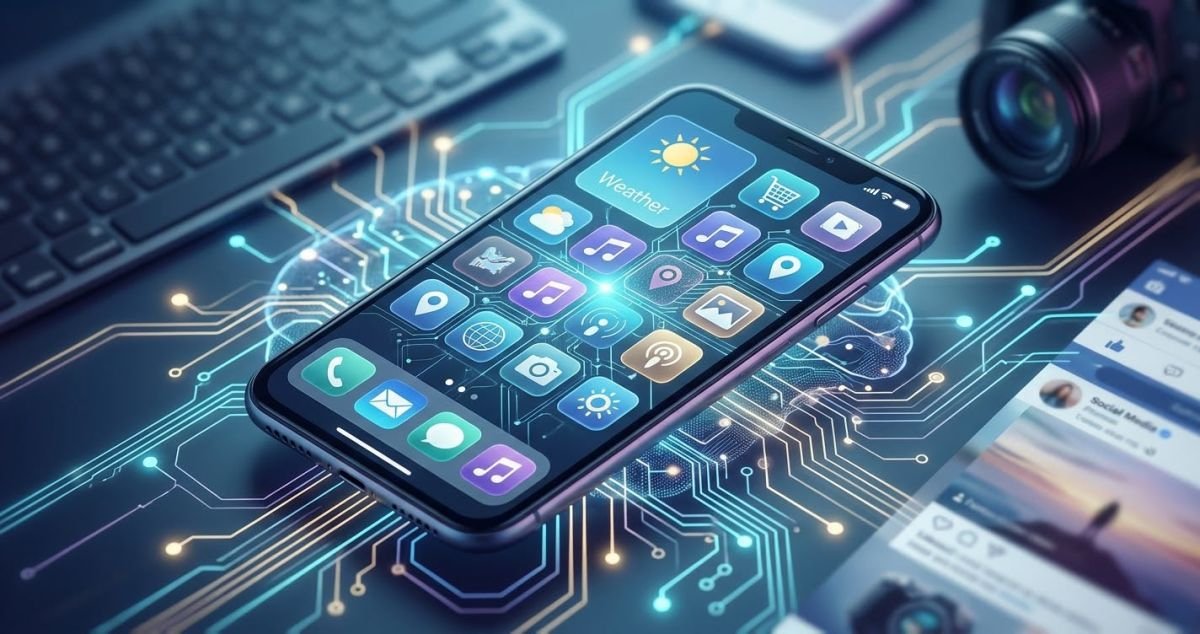
What Happens When AI Becomes Part of an Everyday App Without You Noticing
You open your phone, check the weather, send a message, take a photograph, find directions and shop.None of these involve something called an artificial intelligence.
There's no chatbot, no robot voice and no notice that "Your AI Assistant is standing by."
But that doesn't mean your phone or applications aren't making use of AI anyway.
According to guidance from government regulators published in 2026 , people are already encountering AI in their daily lives in the form of search, recommendations, fraud detection, customer service and decision support tools .This has real impact on the relationship we have with technology.
AI Can Be Much Harder to Spot Than a Robot Voice
When most people think of AI, the default assumption is that it involves a chatbot-like interface.That's understandable because that's what most people encounter.
It includes "a machine-based system that makes predictions, recommendations, or decisions characterized by adaptability and autonomy, that are informed by human values and goals."
A surprising number of technologies fall under this category, including search, recommendation, fraud detection, automation and other tools that appear in a growing number of applications.This includes tools that have nothing to do with a chatbot-like interface.In fact, it can be hard to tell when you're using a piece of technology that qualifies as AI.
Because the tools are designed to be unobtrusive, their value tends to be hidden until you realize that someone has made your life easier in some way.
For example, if you can find the objects you're looking for more easily, you may not think about whether a recommendation system is involved.It can be much harder to notice than a robot voice on the other end of the line.
Your Apps Are Starting to Make Suggestions for You
One of the most interesting developments surrounding AI is the shift from asking for information to making suggestions.If you're using a music app, for example, you no longer have to ask for specific recommendations.The app can infer what you might be interested in based on your behavior and suggest it to you.The same approach can be used for a broad range of tasks.
A number of technologies can analyze your behavior to determine what might be relevant, including:
What results to return for a search
What links to click on
What messages are likely to be spam
What objects appear in a photograph
What actions to perform next
Note that you're not always interacting with "big" decisions.
Each small suggestion has an impact, and the cumulative effect can be substantial.
You May Start Seeing Suggestions Everywhere You Look
If you're using a photo app to look for certain objects, it's entirely possible that you'll discover other similar objects without realizing it.
There's no chatbot informing you that an AI-based system is at work.
Instead, you simply notice that it's much easier to navigate your photos in certain ways than others.A similar situation occurs with voice typing.
There's no robot voice telling you what's happening - but you may notice that your phone can make suggestions for words you're likely to type. According to [Apple]their on-device intelligence powers features such as photo and scene recognition in Photos and predictive text. One reason for this trend is that developers want users to forget they're using AI.
The technology is designed to be invisible, and the only reason you might realize it's there is if you discover that an app has suddenly become much more convenient or capable than before.
Some Technologies Are Running Right on Your Device
Another important consideration involves the fact that some AI tools are running right on your device.They don't have to send information to a remote server in order to perform their calculations, return results and protect your privacy.
The phrase "AI is being used" doesn't automatically indicate that the technology is doing something that requires sending information over the Internet.
For some operations, the work can be done on your phone or computer.For others, the task has to be sent to a cloud-based server.It depends on what you're asking for and how the application is designed.
An App Can Become More Powerful Without Looking Much Different
One fascinating implication of all these changes is that an application can become fundamentally different without looking much different at all.
The same buttons can be in the same places, but the actions they perform can be radically different.
A search box might become much more powerful.
A photograph might be used to identify objects or people.
A navigation app might use prediction to provide radically different results.
A shopping app might display different products.
Each of these changes could happen while the application looks largely the same as before.
That's one reason it can be hard to tell when AI is involved.
The changes aren't always dramatic, and the only sign that anything has changed may be that the app has somehow become more powerful or convenient than before.
Recommendations Are One of the Easiest Ways to See How AI Has Changed Things
It's hard to go through a day without encountering a recommendation in some capacity.
If you're watching videos, you're likely to encounter a recommendation for a different video. If you're listening to music, you're likely to encounter a recommendation for a different playlist. If you're browsing products, you're likely to encounter a recommendation for a different item.
The exact technology used to deliver these recommendations can vary from one application to the next.It's therefore impossible to generalize about the specifics of how recommendations work.
But they're all examples of an automated recommendation algorithm attempting to predict what you might want to see or do.
The key change involves the fact that an application is no longer simply reacting to your requests.It's attempting to anticipate them.
Your Work Can Become Easier - and More Personalized
One of the easiest ways to encounter AI is through an increase in convenience.
If you're using an app that understands what you want to accomplish, it can make many tasks much easier.You might not have to examine as many photos to find the ones you want.You might not have to type as much text.You might receive useful recommendations before you even realize you need them.
This is one reason recommendation algorithms and other AI-driven tools can be incredibly valuable.
They make apps more personalized, and that personalization can make the tools dramatically easier to use.But there is a catch.
You have to consider what information the app has used to deliver those recommendations.That's especially true if you're using an app that already has access to a significant amount of personal information.
The Privacy Implications Are Especially Important
Most people don't expect a standard calculator to know much about them.
But a personal assistant might know a surprising amount of information.
An AI assistant running inside an app may be able to review your messages, documents, photographs, location data and more.
That doesn't mean that all AI assistants are likely to collect all of that information, but it's important to remember that "AI" doesn't always tell you much about the information being processed.That means it's especially important to understand what information is being processed when you're using an app that claims to use AI.
AI Can Operate Completely Invisibl
Perhaps the most important change involves the fact that AI no longer has to ask for your input in order to function.
A system can analyze the information available to it and take action based on that analysis.
Google has noted that vision for Android is to bring a richer, more intuitive mobile experience that anticipates users' needs and wants, and delivers on them - with less effort."This approach has already led to a number of interesting developments, including tools that operate invisibly in the background.The shift represents a change in the relationship between users and technology.
Apps and websites have traditionally been designed around the idea of waiting for input from the user.
You click a link, you type information, you make a selection.An AI-driven application may be able to make some of those interactions much less visible.That's especially true if it can accurately predict the actions you want to take.
The App Can Become More Powerful, More Convenient - and Much More Complicated
Adding an AI layer to an application doesn't automatically make it better, however.
A prediction is only as valuable as the information that leads to it.
A recommendation can miss the mark.
An automated action can fail to meet your needs.
Even more importantly, an application that already has access to personal information may raise difficult privacy questions
When an AI tool is making suggestions that seem surprising or unhelpful, the biggest challenge may involve determining what went wrong and how it should be fixed.
There's No Obvious Indicator That Tells You When AI Has Been Used
Some companies make it easy to identify AI features.
When an application includes a chatbot or other clearly identified AI tool, there's no confusion about what you're interacting with.But other companies make it much harder to distinguish between regular and AI-enhanced apps.
Some companies use labels such as "smart" to identify features that make use of machine learning.Other companies hide such features completely, and they aren't always obvious to the end user.
It's not that people aren't aware of AI, but rather that it's often presented as a general enhancement to the capabilities of the application.
What Has Changed for You as an End User?
There are a number of ways an application can begin to behave differently when it begins making use of AI, but most changes are relatively subtle.Instead of interacting with a chatbot or asking for specific information, an application can begin making suggestions.
This typically leads to a few important changes:
Reduced work: Some manual tasks can be automated or reduced
More personalization: Applications can become dramatically more useful and relevant
Faster interactions: Some actions can be performed without going through lengthy processes
Greater automation: Some actions can be taken without direct input
Greater risk of error: Recommendations can fail to meet expectations
Reduced transparency: It can be harder to tell why certain actions have occurred
Privacy implications: Personal information can be used in ways that aren't always clear
Reduced control: The automation can make it harder to customize or alter the behavior of an application
These changes are rarely dramatic, but they can combine to substantially alter the experience.
The Line Between Feeling Valued and Feeling Creeped Out Can Be Thin
There's a reason why many users are often enthusiastic about recommendation algorithms, but wary of the same technology when it comes to other aspects of their lives.
If your phone makes it much easier to accomplish everyday tasks, it can feel incredibly valuable.At the same time, it can feel deeply unsettling if an application begins to behave as if it knows much more about you than it should.The difference between feeling valued and creeped out often comes down to control.
You should always be aware of what a feature is doing, what information it uses and how it alters your experience.
What Do You Need to Ask About When an Application Changes?
You don't have to be an expert on AI to ask the right questions when an application changes.If you're using a familiar application that has suddenly become much more capable, it's always a good idea to ask yourself the following questions:
What has changed? What new feature is responsible for the improvements?
Where is the work being done? Does the application process information on your phone or does it have to be sent somewhere else?
What information is being used? How much does the application know about you?
Can you turn it off? Can you stop the feature from behaving this way?
Can you review or delete information? Can you prevent the application from doing anything that might bother you?
Does the feature make recommendations or take actions automatically? Can you customize its behavior?
What does the company's privacy policy say? How much information is being collected, and what is it being used for?
These questions are especially important if you're using an application that handles private messages, photographs, documents, financial transactions, work-related tasks or other information that you want to keep secure.
AI Has Become Much More Integrated Into Apps Than You Might Realize
Artificial intelligence has long been presented as a separate entity: a specialized "AI app" that you visit when you want assistance. You ask it a question, and it provides an answer. But that's not the only way AI has been incorporated into our lives.
Increasingly, it has been invisibly integrated into applications that we already use on a daily basis.
As a result, you may not always realize when an application has been updated to include new features that make it dramatically more capable.You won't always open an "AI app" or encounter a chatbot.Instead, AI features may be hidden within your camera, keyboard, search tools, email, navigation software or other common applications.And eventually, you'll stop noticing them at all.
tl;dr
When AI becomes part of an everyday application without you noticing, the biggest change is often invisible at first.
As discussed in this article, familiar applications and tools can begin to predict, recommend, automate, personalize and recognize things without requiring you to ask for them directly.
This ability is rooted in the NIST which encompasses a broad range of technologies and approaches, not just chatbots. The ability to operate this way can make applications much more convenient, but it also means that questions about privacy, transparency and control become much more important.
The most surprising aspect of this transition is that AI doesn't reveal itself by announcing itself. Sometimes, the biggest sign that it has had any impact at all is that an app has quietly become much more powerful than before.